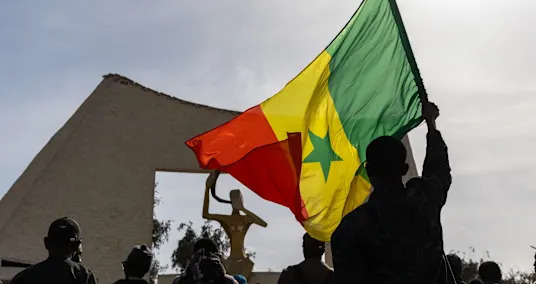
Senegal's President Bassirou Diomaye Faye has signed a new law doubling to 10 years the maximum prison term for sexual acts by same-sex couples.
The new law also criminalises the "promotion" of homosexuality, which includes any public representation and financial support by individuals or organisations, and provides for three to seven years in prison for those found guilty.
The legislation was a campaign promise of President Faye and Prime Minister Ousmane Sonko and was approved by parliament last month.
UN rights chief Volker Türk has described it as "deeply worrying", saying that the anti-LGBT legislation "flies in the face of sacrosanct human rights".
The UN official and rights groups had urged the president not to sign it into law, but the government dismissed the international criticism, arguing that the measures reflected the views of Senegalese people.
It was taken to parliament after a wave of arrests over alleged same‑sex relationships, which were already banned under Senegalese law.
In February, 12 men, including two public figures and a journalist, were arrested and charged with "acts against nature".
Campaign group Human Rights Watch has recently noted a rise in "hostility toward LGBT people", adding that MPs had twice – in 2022 and 2024 - unsuccessfully sought to raise jail terms and penalties against same-sex relationships.
The new law was passed by an overwhelming majority in the National Assembly on 11 March, with 135 MPs voting in favour, none against and three abstaining.
Several other African countries have also introduced tough new laws against the LGBTQ+ community in recent years.
In September last year, Burkina Faso's transitional parliament approved a bill banning homosexual acts, following its neighbour Mali in 2024.
In 2023, Uganda voted in some of the world's harshest anti-homosexual legislation, meaning that people engaging in same-sex relationships can be sentenced to death in certain circumstances.
Ghana is also planning to re-introduce an anti-homosexual bill that activists say threatens basic human rights, safety and freedom.
You may also be interested in:

Go to BBCAfrica.com for more news from the African continent.
Follow us on Twitter @BBCAfrica, on Facebook at BBC Africa or on Instagram at bbcafrica
BBC Africa podcasts
latest_posts
- 1
 Toilet rats? Washington health officials warn of possible rodents in sewer systems after floods
 - 2Fundamental Home Machines for Improved Solace in Summer
- 3Italy Brings In New Measures In 2026 To Tackle Overtourism
- 4The Iconic, Instantly Recognizable Plastic Chair That's Known All Around The World
- 5Why the UAE has incurred the wrath of Somalia





- Avoid Slam: Clearing the Street for the Eventual fate of Standard Size Trucks
- Warnings rise for U.S. as severe flu strain causes outbreaks in Canada, U.K.
- Germany raises prospect of military forces to secure Ukraine peace
- 'Harmonious' meeting between Merz, Lula despite Belém controversy
- Heartfelt Objections to Visit with Your Adored One
- We tasted one of the 10,000 Hershey's Dubai chocolate bars being resold on eBay. Is it worth the hype?
- Hidden Island Cameras Capture Rare Tasmanian Species for the First Time Ever
- James Webb Space Telescope's mysterious 'little red dots' may be black holes in disguise
- Climate change is straining Alaska's Arctic. A new mining road may push the region past the brink