When you buy through links on our articles, Future and its syndication partners may earn a commission.

HOUSTON — Talk about a looky loo.
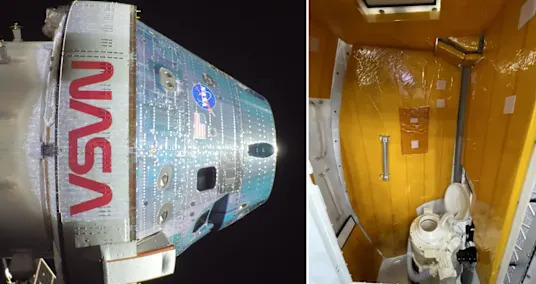
As the four astronauts of NASA's Artemis 2 mission to the moon close in on their historic lunar flyby — the first by a human crew in more than 53 years — an unusual star has risen aboard their Orion moon ship. But it's not an astronaut — it's the space toilet.
That moon loo has been part of the Artemis 2 conversation since day one of the mission, when its urine function went offline and was fixed by mission specialist Christina Koch, with guidance from Mission Control.
"I'm proud to call myself the space plumber," Koch told reporters in a live video interview on Friday (April 3). "I like to say that it is probably the most important piece of equipment on board. So we were all breathing a sigh of relief when it turned out to be just fine."
But the toilet wasn't fine. Or at least, not 100% fine. In the days that followed, the astronauts reported an odd "burning smell" coming from Orion's hygiene bay" — essentially a small bathroom compartment about the size of a small jet's lavatory. The smell reminded the crew of the odor from an electrical heater being turned on for the first time in a long while.
Debbie Korth, Orion spacecraft deputy program manager, told reporters here on Saturday (April 4) that, while engineers are working to pinpoint the source of the smell, Mission Control isn't overly concerned about the issue.

"So we don't know exactly yet. We're still troubleshooting where they might be coming from," Korth said, referring to the odors.
Mission engineering teams, she added, "think it might be more mechanical in nature — some tapes and some other materials that might be off-gassing — but it's really early in that investigation. So, [I] don't think there's any hazardous condition."
Late Friday, the Artemis 2 crew also had problems venting urine overboard from the toilet's storage tank, which is about the size of an office wastebasket. It stopped after venting just 3% of its load, leading flight controllers to suspect a blockage from ice buildup — something that can easily happen in the cold of space.
So on Saturday, Orion turned to point its urine vent nozzle at the sun for hours in a "bake out" to warm it up, allow urine to be dumped overboard and let the crew start using the toilet to go "number one" again. (For now, they have to use a Contingency Collapsible Urinal device — a plastic container that can be emptied into Orion's tank — to collect their pee and dump it overboard.)

Korth said that the bake out was partially successful on Saturday, with Orion emptying out about half of its toilet tank. Still, the crew wasn't able to use the toilet to pee right away, something that Koch asked about late Saturday night in a radio call to Mission Control here at NASA's Johnson Space Center.
"One question back to you about, when do you expect we might be able to use toilet again?" Koch asked.
"The teams are talking about the signature and they are meeting to get you a forward plan as soon as possible," Artemis 2 CapCom (Capsule Communicator) Jacki Mahaffey radioed back from Mission Control, adding that the plan might come in an hour.
"I copy. Umm, would you authorize one use of the toilet?" Koch asked with a laugh. (Mahaffey said she would check.)
Meanwhile, on Earth, NASA astronaut Don Pettit shared photos of what the contingency urinal devices look like. They are cylindrical plastic containers with an open end to urinate into, with a cap to close it off. An outlet at its base allows it to be emptied into a tank. Each Artemis 2 astronaut has two of the devices.
"When you are in cislunar space with a broken toilet, you need contingencies, and the CCU replaces the need for about 25 pounds of diapers," Pettit wrote on social media.
The Orion toilet is a smaller, more compact version of the toilets used on the International Space Station. The hygiene bay containing it is a small compartment built into the floor of the Orion spacecraft. It cost $23 million to develop the toilet, as Space.com reported in 2020.
It may seem silly to focus so much on the Artemis 2 crew's toilet plumbing problems. Orion's four astronauts are flying to the moon, after all. But the space toilet has become a bit of a star, with reporters asking for updates every day during NASA's mission status briefings.
And that shouldn't be surprising, NASA officials said.
"I think space toilets, and bathrooms, is something everybody can really understand," Korth said of the apparent fixation on Orion's toilet tech. "And we're flying it for the first time. Apollo didn't have that kind of technology in the vehicle."
She has a point. Everybody pees and poops. And the Orion toilet allows astronauts to "go" like no one's gone before at the moon.
"I think the fixation on the toilet is kind of human nature, right?" John Honeycutt, who chairs the Artemis 2 Mission Management Team, told reporters here Saturday. "I mean, everybody knows how important that is to us here on Earth, and it's harder to manage in space … I'm interested in it, too."
NASA's Artemis 2 mission launched on April 1, sending its four-astronaut crew around the moon on a 10-day mission. In addition to Koch, the crew includes Artemis 2 commander Reid Wiseman, pilot Victor Glover (both of NASA, like Koch) and mission specialist Jeremy Hansen of the Canadian Space Agency.
The Artemis 2 astronauts will make their closest approach to the moon in a flyby on Monday (April 6) and return to Earth to splash down in the Pacific Ocean off the California coast on Friday (April 10). You can get live updates on the flight from our Artemis 2 mission updates page.

The only Lego Technic NASA Artemis Space Launch System Rocket, once built it can 'launch' thanks to the clever Technic engineering mechanisms inside. It stands 27.5-inches (70 cm) tall but is made from only 632 pieces, making this suitable for ages 9+, compared with the adult-oriented (and $260) static Lego Icons NASA Artemis Space Launch System (10341) model.
latest_posts
- 1
 South Africa collects record $117B tax haul
 - 2'I was diagnosed with incurable brain cancer on holiday'
- 3Why is everyone talking about Paul Dano? George Clooney becomes the actor's latest defender in this 'time of cruelty.'
- 4It's your last chance to subscribe to Paramount+ before they raise their prices: Here's how to lock in current pricing
- 5Medical team successfully delivers baby and removes massive tumor




- Norovirus is spreading earlier again this year, wastewater data shows
- Step by step instructions to Pick the Right Web-based Degree Program
- Germany's far-right AfD tops poll ahead of Merz's conservatives
- Delta flight bound for Atlanta makes emergency landing after engine issue
- Find the Insider facts of Viable Advertising: Building a Positive Brand Picture
- Cheetos and Doritos to launch new versions without artificial dyes
- The wolf supermoon will kick off 2026 with a celestial bang. Here's when and how to see it.
- Investigating Design and Individual Style: Track down Your Remarkable Look
- Holiday weather forecast: Where travelers can expect a wintry mix, flooding and record warmth across the U.S.