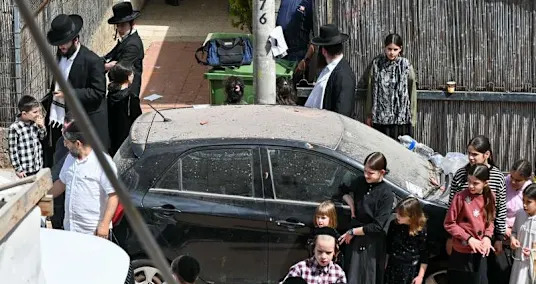
Iran and its Lebanese Hezbollah militia proxy on Thursday fired rockets again at Israel, where people are currently celebrating Passover.
In the morning, warning sirens sounded repeatedly in northern Israel. Two men were slightly injured by a Hezbollah rocket, the Magen David Adom emergency service said.
An Iranian rocket also aimed at the north was fitted with cluster munitions, Israeli media reported. The use of cluster munitions is widely banned internationally because they can scatter explosive devices uncontrollably over large areas and are particularly dangerous for civilians.
There was also repeated fire at Israel overnight. A rocket alert was triggered in the coastal metropolis of Tel Aviv, among other places. Magen David Adom reported several people with minor injuries from broken glass in a suburb of Tel Aviv, including two babies.
The week-long Passover festival began on Wednesday evening for Jews around the world. It commemorates the exodus of the Israelites from Egypt and their liberation from slavery.
latest_posts
- 1
 Treasure trove found in Egyptian tomb solves ancient mystery
 - 26 Web-based Lawful Administrations: Extensive Surveys and Elements
- 3Tech for Learning: Online Courses and Instructive Apparatuses
- 4Israel's fractured opposition hands Netanyahu a full term
- 5Instructions to Really Oversee Unsold SUVs in the Auto Business




- Iran war drives global fertilizer prices up, raising food cost fears
- Holyvolt And Wildcat Could Help The West Reclaim Battery Leadership
- Transcript: NASA's Jared Isaacman on "Face the Nation with Margaret Brennan," April 5, 2026
- My Excursion to a Better Way of life: Health Experiences
- See the moon shine with Saturn in the southern sky after sunset Dec. 26
- Parents search for children missing since a volcanic eruption in Colombia 40 years ago
- Doctors seek to understand why quitting antidepressants causes withdrawal for some
- What will happen if Artemis 2 astronauts get hit by a solar storm during NASA's ambitious moon mission?
- Winter storm headed for Midwest to Northeast. Here's how much snow to expect.