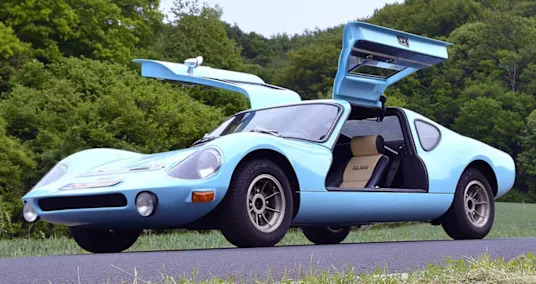
During the communist era, Eastern Europe was not exactly fertile ground for sports cars. Luxury sedans were reserved for political elites, and genuinely sporty vehicles were almost nonexistent, aside from a few modest coupes from Škoda. For most people, transportation meant a Lada, a Trabant, or something similar.
Then came the Melkus RS1000, a car that shattered expectations, at least visually, and proved that passion could survive even inside a planned economy.
The story begins with Heinz Melkus, a respected competitor in Formula Junior and Formula 3. By the late 1960s, Melkus decided to channel his racing background into something far more ambitious: a sports car bearing his own name.

In 1968, Heinz Melkus began seeking approval for a car called the RS, short for Rennsportwagen, framing it as a project to honor the upcoming 20th anniversary of the founding of East Germany in 1969. In the Eastern Bloc, this idea bordered on the absurd. Central planning dictated what manufacturers could build, and a sports car was hardly considered a societal necessity. Still, Melkus leveraged his reputation and connections and somehow secured official approval.
Built Around Wartburg Bones
The Melkus RS1000 was developed using the Wartburg 353 as its technical foundation. Nearly every component was modified, but the basic architecture and the 992 cc two-stroke engine came directly from the Wartburg.
In standard form, that engine produced about 50 horsepower. In the RS1000, output is commonly quoted around 68 horsepower from a tuned version of the Wartburg 992 cc three-cylinder engine, typically described as using multiple carburetors and other internal changes rather than a simple carburetor swap. Power was sent to the rear wheels through a five-speed manual transmission, an unusual feature in its market at the time.
Modest Power, Respectable Performance

By late 1960s standards, the RS1000 delivered respectable performance. It accelerated from 0 to 62 mph in roughly 12 seconds and reached a top speed of about 103 mph. Racing versions were far more extreme, producing up to 118 horsepower and pushing top speed close to 130 mph, remarkable numbers for a two-stroke car from East Germany.
A Shape Inspired By Maranello
Styling was where the Melkus truly shocked people. Its low nose and flowing lines were clearly inspired by the Ferrari 250 GTO, especially at the front. The body was made from fiberglass-reinforced material, and curb weight is commonly quoted in the roughly 1,520 to 1,760 lb range depending on specification and source, so exact comparisons to the Wartburg sedan vary.
There was, however, a catch. Payload capacity was limited, so occupants and luggage had to be kept light, a reminder of how purpose-built the car really was.
A True Rennsportwagen
Ownership was restricted in a way that made the RS1000 even more exclusive. To buy one, applicants generally had to provide proof of racing activity through the ADMV, the East German motorsport association, reinforcing its identity as a true Rennsportwagen rather than a casual road toy. Distribution also flowed through official channels rather than a conventional retail network, and waiting times could be lengthy.
Price was another barrier. At around 30,000 East German marks, the RS1000 cost several times as much as a typical Trabant. Safety equipment was minimal even by the standards of the time. There was no ABS or airbags, and braking performance was modest by modern standards.
A Brief Modern Revival

The RS1000 story did not end there. At the Frankfurt Motor Show in 2009, Heinz Melkus’s grandson unveiled a modern reinterpretation of the RS1000. It was a Lotus Elise-based design that debuted with a turbocharged Toyota-sourced 1.8-liter four-cylinder in early specifications, while later RS2000 versions were also described with a 2.0-liter turbo. Production was intended to be limited to about 25 cars per year, but sales fell short, and the revived company filed for insolvency in 2012.
Even so, the original Melkus RS1000 remains a fascinating symbol of defiance and creativity. It was never fast enough to rival true Western supercars, but in the context of its time and place, it might as well have been a Ferrari. And yes, the sound alone makes the video absolutely worth watching.
This article originally appeared on Autorepublika.com and has been republished with permission by Guessing Headlights. AI-assisted translation was used, followed by human editing and review.
latest_posts
- 1
 UN mission says no evidence Hezbollah rearming in southern Lebanon
 - 2The Specialty of Compromise: Examples from Reality
- 3Asia's migrant workers debate if Gulf jobs are worth deadly risk of Iran war
- 4NASA begins the countdown for humanity's first launch to the moon in 53 years
- 5California warns of death cap mushrooms outbreak resulting in 3 deaths




- IDF continues counterterrorism operations in Gaza Strip, including destroying terror tunnels
- Courageous Climbing: Trails and Stuff for Outside Lovers
- Vote In favor of Your #1 sort of film
- Island Travel Guide: Must-Visit Objections for 2024
- This country music star spent years hiding his sexuality. Coming out — and beating addiction — has made his soul feel '20 pounds lighter.'
- Cyber Monday 2025: Save over 70% on HBO Max with this Prime Video streaming deal
- Witness the elegance of the cosmic butterfly in a remarkable telescope photo
- Virtual National Science Foundation internships aren’t just a pandemic stopgap – they can open up opportunities for more STEM students
- German finance minister sees advantages of smartphones in schools