Protests took place in Tel Aviv, Jerusalem, Haifa, and Beersheba, as a survey found broad but uneven support among Jewish Israelis for Operation Roaring Lion.
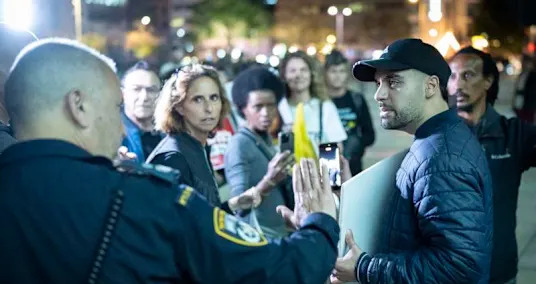
Israel Police arrested 21 anti-war protesters Saturday night as demonstrations against the conflict with Iran expanded in multiple cities despite restrictions on public gatherings.
Protests took place in Tel Aviv, Jerusalem, Haifa, and Beersheba, with hundreds of participants reported in Tel Aviv and Jerusalem and about 100 in Haifa, marking the largest turnout since weekly demonstrations began. Authorities said 13 people were arrested in Tel Aviv and eight in Haifa.
Police said the gatherings were not approved under Home Front Command regulations that ban events with more than 50 people. Officials said the increase in turnout followed calls by groups opposing the government to protest despite the restrictions.
“During a situation assessment that took place at the scene with a Home Front Command representative… it was clarified that there was a real risk to human life and accordingly, Yarkon [precinct] police commander Tzachi Sharabi ordered the gathering to be dispersed,” police said.
Hadash-Ta’al chairman Ayman Odeh, an Arab lawmaker involved in the protests, criticized the police response, calling officers fascists “in the service of the government” and saying they were afraid of “the heroic citizens who went out, despite everything, to make their voice heard.”

Survey shows broad, uneven support for war
The demonstrations come as a March 2026 survey by the Israel Democracy Institute found broad but uneven support among Jewish Israelis for Operation Roaring Lion. Support was strongest on the Right at 87% and about half on the Left.
The survey also found that Jewish and Arab respondents largely agreed that Iran’s resilience has been stronger than expected. Most Jewish respondents said Israeli society could sustain the campaign for up to one month, while 28% said as long as needed. Arab respondents were less optimistic about how long the public could endure the conflict.
A majority of Jewish respondents said Prime Minister Benjamin Netanyahu’s decision was driven by security considerations, while most Arab respondents viewed it as political.
latest_posts
- 1
 Geomagnetic storm grounds launch of Mars space weather satellites
 - 2Watch Rocket Lab launch Japanese technology-demonstrating satellite to orbit tonight
- 3She was the supermodel dubbed 'The Face' in the '80s. Joining OnlyFans in her 60s taught her a lot.
- 4What were the little white pills found in Tiger Woods's pocket at the scene of his crash? What to know about hydrocodone.
- 5I'm an 83-year-old yoga instructor. I'm not your typical grandma — I still work to feel fulfilled and supplement my Social Security.




- The Iconic, Instantly Recognizable Plastic Chair That's Known All Around The World
- Jill Hennessy was a '90s TV staple. Now she's in her fearless era.
- Hot peppers sent him to the ER. Two years later, a ‘ghost bill’ arrived.
- Whale stranded in the Baltic Sea swims free again. It still faces a tough task
- Here are 10 stores where you can get a free Thanksgiving turkey
- ISS astronauts spy airglow and dwarf galaxy | Space photo of the day for Jan. 13, 2026
- Exploring the Difficulties of Co-Nurturing: Individual Bits of knowledge
- When faith comes under fire: How Iran’s repression of religious minorities has increased
- Fears of global aluminum shortages intensify