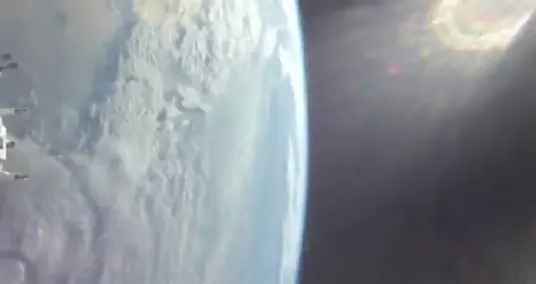
A team of researchers discovered a new type of astronomical object that may help experts learn more about the formation of galaxies and the development of the early universe.
NASA dubbed the object "Cloud-9" and described it as a "starless, gas-rich dark-matter" hydrogen cloud and remnant of the universe's early formation about 14 million light-years from Earth. Scientists have theorized about such an object, but this is the first time one has been confirmed to exist, NASA said. These types of clouds are believed to be dark matter clouds that couldn't accumulate enough gas to form stars, NASA said.
Cloud 9 was identified three years ago, but it wasn't until recently that the Hubble Space Telescope could be used to confirm there were no stars inside. Alejandro Benitez-Llambay, an assistant professor at Italy's Milano-Bicocca University and the principal investigator on the Hubble team, said that Cloud-9 tells the "tale of a failed galaxy."
"In science, we usually learn more from the failures than from the successes," Benitez-Llambay said. "In this case, seeing no stars is what proves the theory right. It tells us that we have found in the local universe a primordial building block of a galaxy that hasn't formed."

The core of Cloud-9 is made up of neutral hydrogen. It is about 4,900 light-years in diameter, NASA said. The hydrogen is estimated to measure one million times the mass of the sun.
Cloud-9 also includes a huge amount of dark matter -- about five billion solar masses worth, NASA said. Andrew Fox, a member of the team who studied the object, called it a "window into the dark universe."
"We know from theory that most of the mass in the universe is expected to be dark matter, but it's difficult to detect this dark material because it doesn't emit light," said Fox. "Cloud-9 gives us a rare look at a dark-matter-dominated cloud."
NASA said the cloud also "suggests the existence of many other small, dark matter-dominated structures in the universe." Those kind of objects can be hard to study, because nearby bright features like stars and galaxies outshine them. Researchers also typically focus their attention on those brighter structures, NASA said. Because those items are hard to study, the findings from Cloud-9 help provide new insights, NASA said.
Cloud-9 is the ninth gas cloud identified on the outskirts of the nearby spiral galaxy Messier 94, NASA said. Cloud-9 is smaller, more compact and highly spherical compared to those other clouds. It also appears to have a "physical association" with Messier 94, NASA said.
Astronomers will conduct further surveys into Cloud-9 to learn more about dark matter, failed galaxies and the early universe itself, NASA said. They will also search for other similar objects.
"Among our galactic neighbors, there might be a few abandoned houses out there," said researcher Rachael Beaton, of the Space Telescope Science Institute.
Cloud-9 may continue to change and could even grow into a galaxy if it continues to expand, NASA said.
Former Trump national security adviser H.R. McMaster on Venezuela raid that captured Maduro
Russia reacts to U.S. military operation in Venezuela after Trump slams Putin
latest_posts
- 1
 Flu season is ramping up, and some experts are "pretty worried"
 - 2Role reversal: Ukraine moves training home and exports the lessons abroad
- 3U.S. to drop childhood vaccine recommendations as it looks to Denmark, Washington Post reports
- 4How to avoid or deal with an outrageous medical bill
- 5Top notch DSLR Cameras for Photography Devotees




- Artemis 2 astronauts head for the moon after make-or-break engine burn (video)
- Scientists solve the mystery of 'impossible' merger of 'forbidden' black holes
- Find the Interesting Universe of Computerized reasoning: the Capability of man-made intelligence
- Elanco's drug gets emergency nod to treat deadly flesh-eating parasite in cats
- The new queen of country music has no scandals and no gimmicks — and just broke a record set by Taylor Swift
- Doctor's orders: Eat ice cream, and other tips for a long and healthy life
- Collins Foods to offload 20 Taco Bell outlets in Australia
- When does Spotify Wrapped come out? The music streamer says 'soon.'
- Vote In favor of Your Number one Cell phones